The NZ Car Selling & Scrapping Glossary: Every Term Explained in Plain English
WoF or CoF? Rego or registration? Repairable or statutory write-off? Here are 68 terms you'll come across when you sell, write off or scrap a vehicle in New Zealand, each explained in a few sentences with a link to the full guide where you need more.
✍️ By Leo Raines — Scrap Car Buyer Specialist, Canterbury · Published 4 November 2026 · 18 min read
How to use this glossary: jump to a letter below, or search the page (Ctrl+F or Cmd+F) for the word on your paperwork, quote or WoF sheet. Every term has its own link (the # beside it), so you can send someone straight to a definition. Where a topic needs more than a paragraph, we link to the full guide.
Selling or scrapping a car in New Zealand comes with its own vocabulary. A buyer mentions a PPSR check, the insurer calls your car a statutory write-off, NZTA asks for a notice of disposal, and the person on the phone talks about kerb weight and cat value. Most of these words matter, because they affect what your car is worth, what you're legally responsible for and whether the money ends up with you.
We buy vehicles across Canterbury every day and explain these terms to sellers constantly. This page collects them in one place, in plain English, with New Zealand law and NZTA practice in mind. We've written it for car owners, but it's also designed to be a reliable reference for students, journalists, community workers and anyone else who needs a clear definition.
The Six Mix-Ups That Cost Sellers the Most
Most confusion comes from pairs of terms that sound alike but mean very different things. Get these six right and you'll understand most of the paperwork around a car sale.
| Often confused | The difference | Why it matters |
|---|---|---|
| Registration vs rego (licence) | Registration happens once. Licensing is the recurring fee. | Unused licence time can be refunded when a car is scrapped. |
| Registered person vs legal owner | NZTA's record of who is responsible isn't the same as legal ownership. | Matters for estates, separations and cars not in your name. |
| Repairable vs statutory write-off | One can go back on the road after recertification. The other never can. | It changes who will buy the car and what they'll pay. |
| WoF vs CoF | A WoF covers light vehicles. A CoF covers heavy and commercial-service vehicles. | A lapsed CoF on a truck or large van is a different problem from a lapsed WoF. |
| Notice of disposal vs acquisition | The seller files immediately. The buyer files within seven days. | Only the seller's notice protects the seller from later fines and tolls. |
| Clean Car Discount vs Standard | The discount ended on 31 December 2023. The standard still applies to importers. | Neither affects selling or scrapping a car you already own. |
A
- #Abandoned vehicle
- A vehicle left on a road or public place that appears to have no owner looking after it. In Canterbury, Waka Kotahi investigates and can tow it, but the process can take up to 90 days while it tries to trace the owner under section 356 of the Local Government Act 1974. AT does not remove cars from private property. If an abandoned car is on your land, see our guide to selling a car that isn't in your name.
- #Accident-damaged car Also: crashed car
- Any vehicle with collision damage, from a cracked bumper to a bent chassis. Its value depends on whether the damage is cosmetic, mechanical or structural, and whether an insurer has declared it a repairable or statutory write-off. See cash for accident-damaged cars.
- #Airbag / SRS fault Also: SRS light
- A warning light for the Supplementary Restraint System (airbags and seatbelt pre-tensioners). An illuminated SRS light is a WoF fail. Deployed airbags usually mean replacing the airbag modules, sensors and sometimes the dashboard, which is why airbag deployment is one of the most common reasons an older car is written off.
- #As is, where is
- A sale on the basis that the buyer accepts the car in its current condition and location, with no promise about faults and no obligation on the seller to deliver it. It is the normal basis for selling to a wrecker or cash for cars buyer. It does not let a seller lie: knowingly misdescribing a car can still be misrepresentation.
B
- #Bait-and-switch quote Also: quote drop
- A tactic where a buyer gives a high price over the phone, then finds "problems" on arrival and cuts the offer once the tow truck is in your driveway. The defence is an accurate description up front and a buyer who confirms the price in writing. See how to get a quote that doesn't drop and how to verify a buyer.
- #Battery (12-volt) Also: lead-acid battery
- The ordinary starter battery in a petrol or diesel car. Lead-acid batteries have real scrap value and contain lead and acid that must be recycled, never dumped. Removing the battery before a wrecker collects usually reduces your quote by more than the battery is worth to you.
C
- #Catalytic converter Also: cat
- An exhaust component that uses small amounts of platinum, palladium and rhodium to clean exhaust gases. Those metals make it the single most valuable part of many scrap cars, and the most stolen. Hybrids such as the Toyota Prius and Aqua are frequent targets. See catalytic converter theft in Canterbury.
- #Certificate of Fitness (CoF) Also: CoF
- The periodic safety inspection for heavy vehicles (gross vehicle mass over 3,500 kg) and for vehicles used in transport services, such as taxis, rental vehicles and buses. It replaces the WoF for those vehicles and is more demanding. Trucks and larger vans that have lapsed their CoF are common candidates for truck wreckers.
- #Certificate of Registration Also: rego papers, ownership papers
- The paper document NZTA issues showing the registered person for a vehicle. Despite the common name, it is not proof of legal ownership. You don't need it to sell a car in New Zealand, although it helps a buyer confirm details.
- #Change of ownership
- The two-part process of telling NZTA a vehicle has changed hands: the seller files a notice of disposal and the buyer files a notice of acquisition. It can be done online or at an NZTA agent. See the notice of disposal walkthrough.
- #Clean Car Discount
- A government rebate and fee scheme on imported light vehicles based on their CO₂ emissions. It ended on 31 December 2023. It is often confused with the Clean Car Standard, which still applies.
- #Clean Car Standard
- A rule that sets average CO₂ emission targets for the light vehicles that importers bring into New Zealand. It applies to importers, not to people selling or scrapping a car they already own.
- #Consumer Guarantees Act 1993 Also: CGA
- The law that gives buyers guarantees such as acceptable quality when they buy from someone in trade, including a registered motor vehicle trader. It does not apply to private sales between individuals.
- #Consumer Information Notice (CIN) Also: CIN card
- A notice that motor vehicle traders must display on used vehicles they offer for sale, showing details such as the year, odometer reading, whether there's money owing and the trader's details. Private sellers don't need one.
- #Contract and Commercial Law Act 2017
- The law that covers misrepresentation in contracts, including private car sales. If a private seller gives false information that persuades a buyer to buy, the buyer may be able to cancel the sale or claim compensation, typically through the Disputes Tribunal.
D
- #Depollution
- The first stage of recycling a car: draining fuel, oil, coolant, brake and transmission fluid, removing the battery, recovering air-conditioning refrigerant and taking out tyres before the shell is crushed or shredded. It's what separates a responsible wrecker from a paddock. See what happens to your car at the wreckers.
- #Deregistration Also: cancelling registration
- Removing a vehicle from the Motor Vehicle Register, usually because it is being scrapped, exported or permanently taken off the road. A deregistered vehicle can't return to the road without going through entry certification again. Deregistering can also trigger a licence refund.
- #Disputes Tribunal
- A low-cost court for civil claims of up to $30,000, including disputes between private buyers and sellers of cars. Disputes with registered traders usually go to the Motor Vehicle Disputes Tribunal instead.
E
- #End-of-life vehicle (ELV) Also: ELV
- A vehicle that has reached the point where it's going to be dismantled and recycled rather than repaired or resold. In 2023, used-import cars in New Zealand averaged 19.9 years old when they left the fleet. See our NZ end-of-life vehicle statistics.
- #Entry certification Also: compliance
- The inspection a vehicle needs before it can be registered in New Zealand for the first time, whether it's a new import, a used import or a vehicle being re-registered. Japanese used imports go through this when they arrive. See cash for Japanese imports.
F
- #Fair Trading Act 1986
- The law that bans misleading and deceptive conduct by businesses. It covers car traders, wreckers and cash for cars buyers, so a buyer who advertises "free removal" and then charges a fee may be in breach. It generally doesn't apply to one-off private sellers.
- #Ferrous and non-ferrous metal
- Ferrous metals contain iron (steel bodywork, chassis, engine blocks) and make up most of a car's weight. Non-ferrous metals don't (aluminium wheels and engine parts, copper wiring, brass) and are worth far more per kilo. See scrap metal prices in Canterbury.
- #Finance owing Also: money owing
- When a loan secured over a car hasn't been paid off, the lender usually has a security interest registered on the PPSR. The car can't be sold cleanly until the loan is cleared, often from the sale proceeds. See selling a car with finance owing.
- #Flood-damaged car
- A vehicle that has had water inside the cabin or engine. Flood damage attacks electronics, wiring, airbag sensors and engines, often months after the event, so insurers frequently write flood cars off. See cash for flood and written-off cars.
G
- #Gross vehicle mass (GVM) Also: GVM
- The maximum a vehicle is designed to weigh when fully loaded. The 3,500 kg GVM line separates light vehicles (WoF, car licence) from heavy vehicles (CoF, heavy vehicle rules).
- #GST on a vehicle sale
- If you're GST-registered and sell a vehicle you claimed GST on or used in your taxable activity, GST is usually due on the sale price. Private individuals don't charge GST. See selling a business or fleet vehicle.
H
- #Hybrid battery Also: high-voltage battery, traction battery
- The large battery pack that drives the electric motor in a hybrid or EV. A failed pack can cost more to replace than an older hybrid is worth, which is a common reason Priuses and Aquas reach the wreckers. Packs and their cells still have reuse and recycling value. See cash for EVs and hybrids.
I
- #Insurance write-off Also: total loss
- When an insurer decides a damaged car is uneconomic to repair and pays out its value instead. In New Zealand the insurer then classes it as a repairable or statutory write-off. See NZ write-off categories explained.
J
- #Japanese used import Also: JDM import
- A second-hand vehicle imported from Japan, by far the biggest source of New Zealand's used cars. Most of today's older cars, from Corollas to Tiidas and Demios, arrived this way, many of them built between 2005 and 2008.
K
- #Kerb weight Also: curb weight
- What a vehicle weighs empty, with fluids but no passengers or load. Kerb weight is the starting point for a car's scrap value, because a heavier vehicle contains more steel. A typical small hatchback is around a tonne; a double-cab ute can be over two.
L
- #Light vehicle
- A vehicle with a gross vehicle mass of 3,500 kg or less: cars, SUVs, most vans and utes. Light vehicles need a WoF and pay standard licence fees.
M
- #Misrepresentation
- Giving false information about a car, such as hiding a known engine fault or a write-off history, that persuades someone to buy it. It's a legal risk even in an "as is" private sale. The simplest protection is to be honest and put known faults in writing.
- #Motor Vehicle Disputes Tribunal Also: MVDT
- A specialist tribunal that hears disputes between buyers and registered motor vehicle traders, for example under the Consumer Guarantees Act. It doesn't hear disputes between two private individuals.
- #Motor Vehicle Sales Act 2003
- The law that regulates people who trade in cars. Anyone who sells more than six vehicles in a 12-month period is presumed to be a trader and must register on the Motor Vehicle Traders Register.
N
- #Notice of acquisition
- The buyer's half of a change of ownership. The new owner must notify NZTA within seven days of buying the vehicle.
- #Notice of disposal
- The seller's half of a change of ownership, filed with NZTA online or at an agent. It should be done immediately after the sale. Until it's filed, tolls, parking tickets and camera fines can still be sent to you. See the notice of disposal walkthrough.
- #NZTA Also: NZ Transport Agency Waka Kotahi
- The government agency that runs the Motor Vehicle Register, vehicle licensing, WoF and CoF rules, road user charges and changes of ownership.
O
- #Odometer tampering Also: clocking
- Winding back a vehicle's odometer to make it seem to have travelled less than it has. It is illegal. A vehicle history report can show past odometer readings recorded at WoFs, which makes tampering easier to spot.
P
- #Parts car Also: donor car
- A car bought mainly for its parts rather than to drive. Popular models with good engines, gearboxes, panels or interiors can be worth well above scrap value as parts cars. See the 20 cars that pay the most cash at wreckers.
- #Personalised plates
- Custom number plates. Unlike standard plates, they belong to the plate owner, not the car, so transfer them to another vehicle or put them on hold before you sell. Getting them back from a crushed car is hard. See the car handover checklist.
- #Pick-a-part Also: self-service wrecker
- A yard where customers remove used parts themselves. Some also buy cars. Prices and convenience vary compared with a cash for cars buyer that collects. See cash for cars vs Pick-a-Part, Turners and auctions.
- #PPSR Also: Personal Property Securities Register
- The public register, under the Personal Property Securities Act 1999, where lenders record security interests over personal property, including cars. A PPSR check shows whether there's money owing on a vehicle. Buying a car privately with money owing can put it at risk of repossession.
- #Pre-purchase inspection Also: PPI
- An independent mechanical check paid for by a buyer before buying a car. It's useful when buying, and a cheap diagnosis can also help a seller decide whether to repair or sell. See repair or scrap?
- #Private sale
- Selling a car directly to another person, often through online listings. It can get the highest price for a good car, but takes time and carries risks with payments, test drives and disputes. See cash for cars vs private sale.
Q
- #Quote
- A buyer's offer for your vehicle. A good quote is based on make, model, year, condition, whether it runs, location and current metal prices, and holds when the truck arrives. See the 2026 price guide.
R
- #Registered motor vehicle trader Also: MVTR
- A person or business listed on the Motor Vehicle Traders Register under the Motor Vehicle Sales Act 2003. You can search the register before you deal with a car buyer. See is cash for cars legit?
- #Registered person
- The person NZTA records as responsible for a vehicle. This is usually, but not always, the legal owner. The registered person receives tolls, fines and licence reminders until a change of ownership is filed.
- #Registration
- The one-off act of entering a vehicle on the Motor Vehicle Register and giving it plates. What most people call "rego" each year is actually the vehicle licence.
- #Repairable write-off
- A vehicle an insurer has written off for economic reasons but that can legally be repaired. It must be inspected and recertified before going back on the road. Repairable doesn't mean worth repairing. See write-off categories explained.
- #Road user charges (RUC) Also: RUC
- A distance-based charge, bought in 1,000 km units, paid by diesel vehicles, heavy vehicles and, since 1 April 2024, light electric vehicles. Plug-in hybrids also pay RUC. It replaces the fuel tax that petrol drivers pay at the pump. See rego and RUC refunds.
- #Rust (structural)
- Corrosion in load-bearing areas such as sills, chassis rails, strut towers and seatbelt anchor points. It's a WoF fail and often costs more to repair properly than an older car is worth. It's one of the most common reasons cars reach the end of the road in coastal Canterbury.
S
- #Salvage
- Parts or materials recovered from a vehicle for reuse or recycling. New Zealand doesn't use a "salvage title" system like the United States. Instead, write-off status is recorded against the vehicle on the register.
- #Scrap car Also: junk car
- A vehicle whose value comes mainly from its metal and recyclable parts rather than its use as transport. See scrap car removal and the complete guide to selling a scrap car.
- #Scrap value
- What a vehicle is worth as recyclable material. It's driven by kerb weight, steel and non-ferrous metal prices, the catalytic converter, and whether it has saleable parts. See what is my scrap car worth?
- #Shell Also: hulk, body shell
- What remains of a car after the engine, gearbox, interior and valuable parts have been removed. Shells are flattened and sent for shredding, where steel is separated from other materials for recycling.
- #Statutory write-off Also: non-repairable write-off
- A vehicle so badly damaged, usually structurally or by fire or flood, that it can never be registered for road use again in New Zealand. It can only be dismantled for parts and recycled. See write-off categories explained.
T
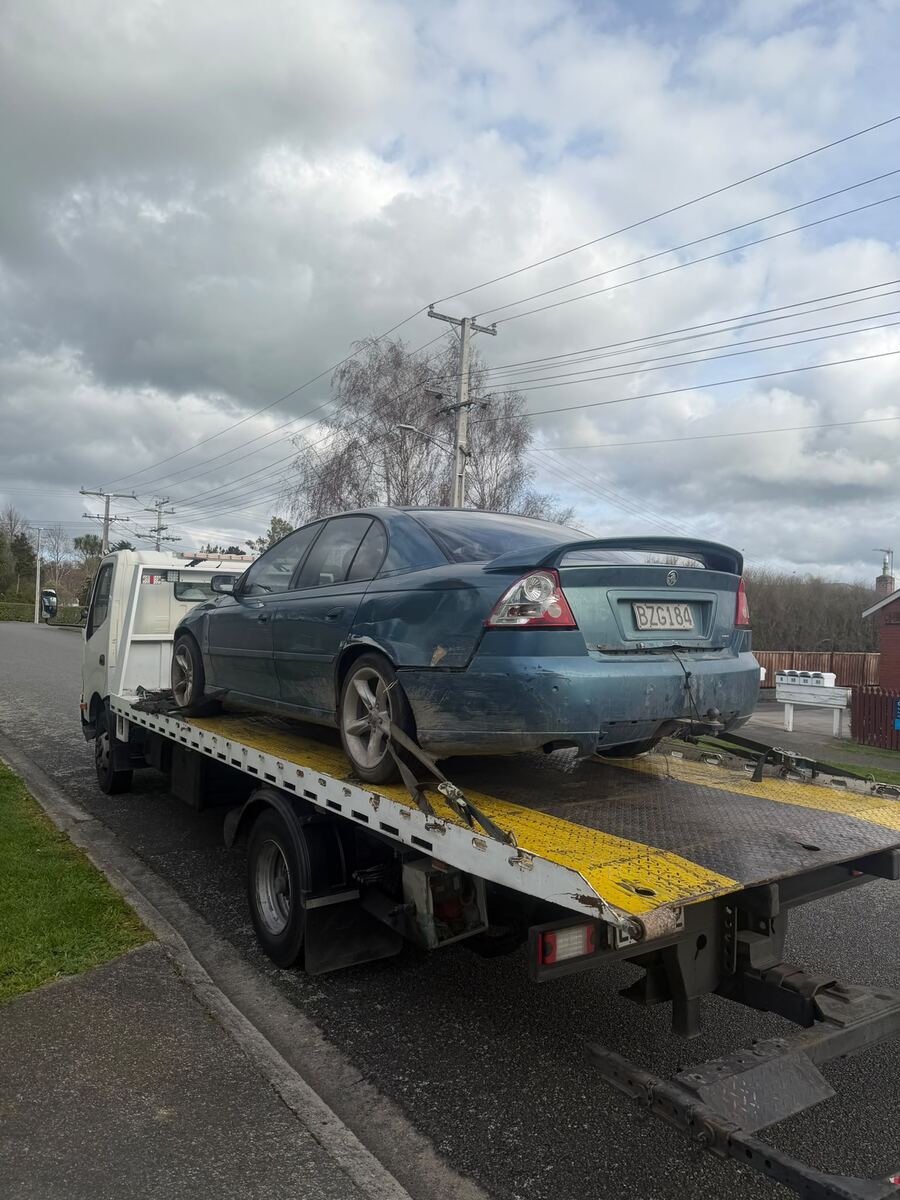
- #Tilt-tray Also: flatbed
- A tow truck with a deck that tilts and slides down to ground level so a vehicle can be winched aboard. It's the safe way to move non-running, crashed or wheel-locked cars. See how same-day car removal works.
- #Tow fee Also: removal fee
- A charge for collecting a vehicle. Reputable cash for cars buyers include towing in the quote. A fee that appears only on the day is a red flag. See free car removal.
- #Tyre stewardship Also: Tyrewise
- New Zealand's regulated product stewardship scheme for end-of-life tyres. A fee is collected when tyres are imported, funding free collection and processing so old tyres aren't stockpiled or dumped. Free collection began in September 2024.
U
- #Unlicensed vehicle Also: no rego
- A vehicle whose licence ("rego") has expired. It can't legally be driven or parked on a road, but it can be sold, and you can still sell it to a wrecker. See selling a car without WoF or rego.
- #Ute
- Short for utility vehicle: a pickup such as a Hilux, Ranger, Navara or Triton. Utes keep their value well in New Zealand, even with high kilometres or damage, because their parts and drivetrains are in demand. See cash for utes and 4WDs.
V
- #Vehicle history report
- A paid report, available from several NZ providers, that pulls register data such as odometer readings, past owners, write-off status, import date and money owing from the PPSR. It's worth running before buying privately.
- #Vehicle licence Also: rego
- The recurring fee that lets a registered vehicle be used on the road, paid for 3 to 12 months at a time. Despite the name, "rego" is technically licensing, not registration.
- #Vehicle licence refund Also: rego refund
- A refund of unused, complete months of vehicle licence, minus an administration fee, that NZTA can pay when a vehicle's licence is cancelled, for example because it's been scrapped. On a normal sale, the remaining licence stays with the car. See how to claim a rego and RUC refund.
- #VIN and chassis number
- The unique identifier stamped on a vehicle. Modern vehicles have a 17-character VIN, while many Japanese used imports are identified by a shorter chassis or frame number. Buyers use it to check the register and the PPSR.
W
- #Warrant of Fitness (WoF) Also: WoF
- The periodic safety inspection for light vehicles. Under the current rules, a brand-new vehicle's first WoF lasts three years. After that, vehicles first registered on or after 1 January 2000 need one every year, and older vehicles every six months. The government has consulted on changing these intervals, so check NZTA for the latest rules. You can still sell a car without a current WoF.
- #Wrecker Also: car wrecker, dismantler
- A business that buys end-of-life vehicles, removes and sells usable parts, depollutes the car, and sends the shell for metal recycling. See car wreckers and cash for cars vs car removal vs car wreckers.
- #Written-off car
- Shorthand for a vehicle an insurer has declared uneconomic to repair. See insurance write-off, repairable write-off and statutory write-off.
Frequently Asked Questions
What is the difference between registration and rego in NZ?
Registration is the one-off act of entering a vehicle on the Motor Vehicle Register and issuing plates. What most people call rego each year is actually the vehicle licence, a recurring fee paid for 3 to 12 months at a time that lets a registered vehicle be used on the road.
What is the difference between a WoF and a CoF?
A Warrant of Fitness (WoF) is the periodic safety check for light vehicles up to 3,500 kg gross vehicle mass. A Certificate of Fitness (CoF) is the stricter check for heavy vehicles over 3,500 kg and for vehicles used in transport services, such as taxis, rentals and buses.
Is the Certificate of Registration proof of ownership in New Zealand?
No. It shows the registered person, the person NZTA holds responsible for the vehicle, who is usually but not always the legal owner. You don't need the paper certificate to sell a car in New Zealand.
What is a statutory write-off?
A statutory, or non-repairable, write-off is a vehicle so badly damaged that it can never be registered for road use again in New Zealand. It can only be dismantled for parts and recycled. A repairable write-off can be repaired and recertified.
What does PPSR mean when buying or selling a car?
PPSR is the Personal Property Securities Register, where lenders record security interests over items such as cars. A PPSR check shows whether there is money owing on a vehicle. If there is, the loan normally has to be cleared before or at the time of sale.
Do I have to tell NZTA when I sell my car?
Yes. The seller must file a notice of disposal immediately after the sale, and the buyer must file a notice of acquisition within seven days. Until the seller's notice is filed, tolls and fines can still be sent to them.
Does the Consumer Guarantees Act apply to private car sales?
No. The Consumer Guarantees Act applies when you buy from someone in trade, such as a registered motor vehicle trader. Private sales aren't covered, although a private seller who gives false information can still be liable for misrepresentation under the Contract and Commercial Law Act 2017.
Can I reuse the definitions on this page?
Yes. You're welcome to quote or link to any definition on this page. Please credit Cash For Cars Canterbury with a link to the page, or to the term's own anchor link.
Cite or Link to This Glossary
Teachers, journalists, community law centres, budgeting services and other websites are welcome to link to this glossary or to any single definition. Each term has a stable anchor link, so you can link straight to it, for example https://cashforcarscanterbury.co.nz/blog/nz-car-selling-scrapping-glossary/#statutory-write-off.
Suggested citation
HTML link
A note on accuracy: These definitions are general information, not legal or tax advice. Rules such as WoF intervals, licence fees and RUC rates change from time to time. Check NZTA, the PPSR and Consumer NZ for your situation. Last reviewed November 2026. If you spot something out of date, tell us at info@cashforcarscanterbury.co.nz.
Selling in Canterbury? You don't need to learn all of this
When you sell to Cash For Cars Canterbury, we give you a firm quote, collect for free on a tilt-tray from anywhere between Māngere, Sumner and Ashburton, pay you before the car is loaded and complete the NZTA paperwork with you on the spot. We buy any make, running or not, with or without WoF or rego, including write-offs. See our cash for cars service, customer reviews and credentials, or call Get a Free Quote.
Related Guides
NZ Insurance Write-Off Categories Explained — Repairable vs Statutory
Read GuideSelling a Car With Finance Still Owing in NZ — The PPSR Guide
Read GuideNew Zealand End-of-Life Vehicle Statistics 2026
Read GuideKnow the Terms? Now Get the Best Price
Honest quotes, free same-day collection anywhere in Canterbury, paid before loading and NZTA paperwork done on the spot. Running or not, any make.